Each Puzzle Piece is a Chance to Rebuild Trust
At the 2025 World Journalists Conference, I saw the challenges facing journalism in transition. It's no longer just about reporting the news, but about identifying seemingly scattered pieces, connecting fragmented details, and weaving them together into a bigger picture of a world rapidly changing under the pressure of climate change.
1. Winters That Have Changed Color (Italy)
Gianmarco Volpe – a foreign correspondent from Italy – didn’t begin his speech with data, but with a memory: “I grew up with white winters in Abruzzo. Now the snow lasts only a few weeks, and the local economy is collapsing.”
Volpe didn’t need a long list of statistics. Just one: many ski resorts in central Italy have shut down permanently, leaving thousands without a livelihood. Climate change is “draining the lifeblood” of once-proud local industries.
“Journalism can’t just tell sad stories. We need to begin something new – through timely storytelling about renewable energy, eco-tourism, and revival from within the affected communities.”
— Gianmarco Volpe, Foreign Correspondent, Italy
2. When Climate Becomes a Security Variable (Canada)
Murray Brewster – veteran journalist at CBC (Canada) – began with a striking number: 141 days. That was the number of days in 2023 when Canada’s military was deployed to respond to natural disasters – a record.
Drawing on documents from NATO, the EU, and the US Department of Defense, he pointed out that climate change is no longer just about weather, but is subtly fueling major crises, from migration to resource conflicts.
“What journalism is lacking is something essential — the ability to connect scattered pieces of a puzzle — to string together individual data points and see the bigger picture: climate doesn’t just cause ecological consequences, it’s reshaping global geopolitics.”
— Murray Brewster, Senior Journalist, CBC, Canada

Author conducting environmental fieldwork.
3. The Storytellers from Africa (Ethiopia)
Tsegahun Asefa – Senior Editor and News Anchor at NBC Ethiopia – spoke of the disappearing Haramaya Lake, of poverty in Somali-Afar, and villages washed away each season by extreme rains.
But he also spoke of hope. Ethiopia has planted more than 20 billion trees under since 2019 as part of the “Green Legacy” campaign — one of the largest ecological restoration efforts in the world, but one that rarely gets mentioned in the global media.
“We don’t need more pity. We need to be heard.” — Tsegahun Asefa emphasized.
“Global journalism must reconnect the disconnected threads of local stories — to see the global scale of climate.”
Tsegahun Asefa – Senior Editor and News Anchor at NBC Ethiopia
4. So Much News, Yet Still Not Enough (South Korea)
Yun Ji Ro – Director of Communications at Next Group (South Korea) – brought in perspectives from media research:
- 71.4% of South Koreans say the media doesn’t cover climate issues enough
- Climate coverage surged between 2019–2022 but declined after 2023.
- Climate stories are often considered “secondary content”, lacking the weight of politics or economics.
She proposed a major shift: Stop seeing climate as just another topic (an item), and start seeing it as a lens (a view). Only then can stories about health, urban life, or education reflect the true nature of our time.
5. What Journalism Can Begin
Returning to Gianmarco Volpe, he concluded with a simple truth: “Journalism can’t save the climate. But it can help restore the trust that has been eroded by fake news, skepticism, and an overload of information with no one to connect the dots.”
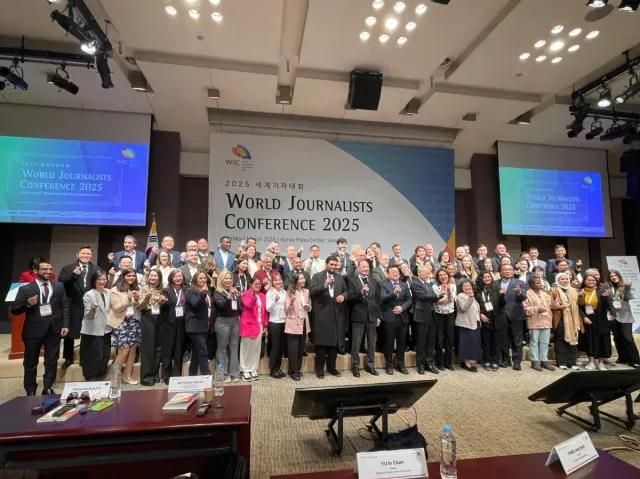
Panorama of the 2025 World Journalists Conference.
Those insights made me reflect on the path I’ve chosen. We don’t have to do extraordinary things, but we can do something meaningful : help people understand the world around them — by connecting the dots, linking fragments, and telling stories in a way that resonates with trust.
(Written from Seoul – World Journalists Conference 2025)
Tags:




43 NGUYEN CHI THANH STREET - BA DINH DISTRICT - HA NOI - VIET NAM
Editor-in-chief: VU THANH THUY
Deputy Editor-in-chief: NGUYEN THI MY HANH, PHAM QUOC THANG, NGUYEN TRONG NINH
Email: toasoan@vtv.vn
Tel: +84 66 897 897
Copyright, VTV News, Vietnam Television (VTV).
Licence No. 483/GP-BTTTT dated December 29, 2023 by the Ministry of Information and Communications.

