
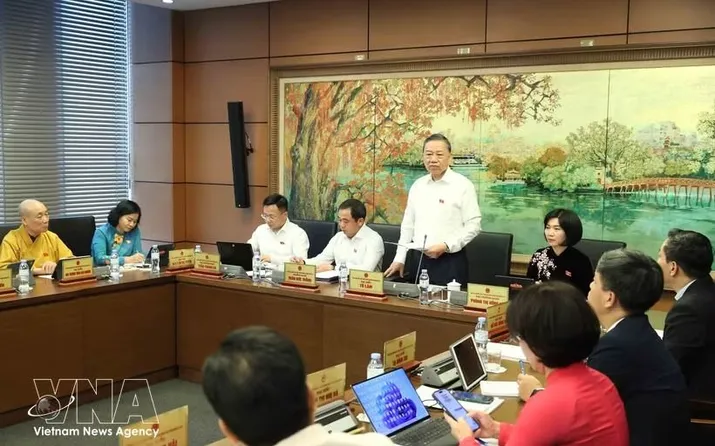
The true measure of a law's success is that goods circulate more smoothly, businesses reduce operating costs, citizens across all regions receive better services with better guaranteed rights, and service prices become increasingly affordable, said General Secretary of the Communist Party of Vietnam Central Committee and President To Lam.
General Secretary and President To Lam emphasised this principle during a group discussion with Hanoi’s National Assembly delegation on October 17, as part of the second session of the 16th National Assembly.
The focus was on the draft amended Law on Postal Services and the draft law amending and supplementing a number of articles of the Law on Measurement.
General Secretary and President Lam said the two draft laws cover sectors that have grown rapidly in recent years, while existing legal provisions have struggled to keep pace with socio-economic development.
He said the laws needed to be amended, but the revisions required careful consideration to meet the country’s development needs.
Regarding the draft law amending and supplementing some articles of the Law on Measurement, he affirmed that despite being a highly specialised technical field, measurement directly affects citizens' daily lives and the nation's development capacity. Inaccurate measurements can cause economic losses, damage businesses’ reputations, affect decisions in criminal and civil cases, and even put lives at risk.
The Party and State leader requested that the legislative process focus on building measurement capabilities to support economic autonomy and technological mastery.
When allocating public funds for measurement standards and digital infrastructure, clear priorities must be set, shared resources used efficiently, and investment effectiveness ensured to prevent waste. Concurrently, state management in measurement must decisively shift from pre-approval inspection to risk-based post-approval inspection with clear accountability, promoting digital transformation and data reuse to curb expenses for businesses, he noted.
Addressing the draft amended Law on Postal Services, General Secretary and President Lam noted that postal operations have evolved far beyond traditional services to become essential infrastructure for the digital economy, deeply integrated with e-commerce, digital delivery, and logistics.
He said the revised law should create more room for development, ensure fair competition and clearly define the boundaries between postal services, transport and e-commerce. It should also simplify administrative procedures by shifting from licensing to registration, backed by effective oversight.
He further underscored the need to efficiently utilise state resources in providing public postal services and to place users' interests at the centre.
The postal service provider entering into the contract should bear ultimate responsibility for incidents involving postal items. Besides, appropriate management mechanisms must be established for delivery personnel, personal data protection, and transparent, convenient compensation processes, he said.
The top leader affirmed that the overall trajectory of the entire economy must be to reduce costs and improve service quality, leaving no room for arbitrary cost increases.


