
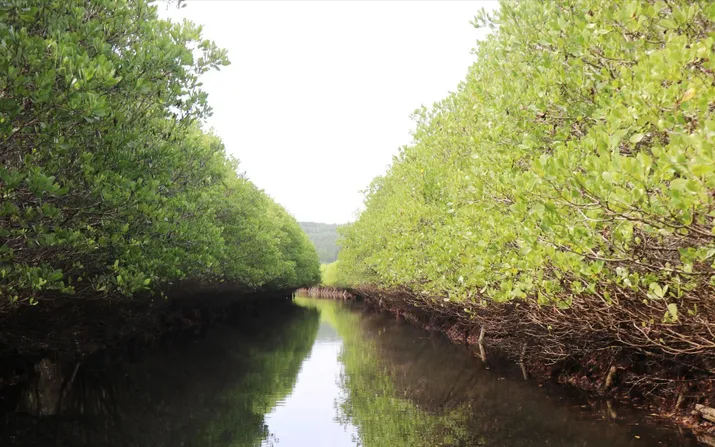
Beyond its biodiversity, the area also provides habitats for birds and aquatic life, while supporting local livelihoods. Residents are now working to protect this ecosystem and develop community-based tourism.
For more than 30 years, Khuong has built his livelihood around the white-flowered mangrove forest. He earns income from fishing and tourism, and says the trees also protect his village from strong winds during stormy seasons.
Nguyen Khuong, a resident of Van Tuong Commune, Quang Ngai Province, said: "I have always seen this forest as something very valuable. Its green cover is a distinctive feature of our lagoon. It allows us to welcome tourists and earn extra income, while also protecting us from strong winds."
Bau Ca Cai covers around 200 hectares and is home to hundreds of thousands of white-flowered mangrove trees. Nearly 70 members of a local community tourism co-operative are working together to protect the forest, while offering boat trips through the mangroves and cultural experiences with local residents.
Pham Thi Tien, a resident of Van Tuong Commune, Quang Ngai Province, said: "We perform local Bai choi songs about our homeland. In this way, we help promote the cultural traditions of our area, especially bai choi."
Responsible care has helped restore habitats for aquatic life, while the forest is becoming an attraction for visitors. Local people are also using social media to promote Bau Ca Cai as the authorities work to expand mangrove planting and improve the wider ecosystem.
Lu The Lam, Vice Chair of Van Tuong Commune People's Committee, said: "This is also an area where the local authorities are committed to further investment, so that community tourism can develop alongside efforts to protect and preserve local values."
Tourism is bringing new opportunities to rural communities in Van Tuong and helping improve local incomes. By working together, residents can continue to protect the white-flowered mangroves, preserve their natural heritage and build a greener, more sustainable future.


