Vietnam promotes innovation across society
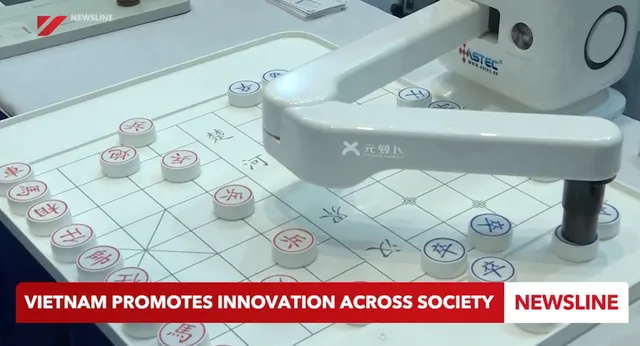
At the technology exhibition, an AI-powered chess robot adapts to players of different skill levels. For young visitors, interacting with AI is both entertaining and an opportunity to explore new technology.
Bui Gia Khang, a resident in Dong Da Ward, Hanoi, said: "I don't think the robot plays as well as my friend. It captured one of my pieces, but then let me capture one that was more valuable."
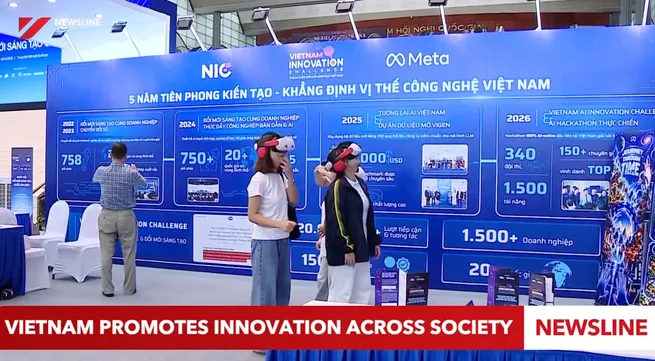
Meanwhile, virtual reality technology offers immersive cultural experiences by recreating historical settings, landmarks and heritage sites.
Nguyen Tien Manh from Holomia Co., Ltd., said: "What you see here is just a small part of what the technology can offer, with a focus on virtual tourism. People can also use the technology for learning, entertainment and exercise, creating highly interactive experiences."
Innovation can emerge from everyday life. But turning ideas into practical solutions requires an open ecosystem connecting government agencies, research institutions, universities and businesses.
Vo Xuan Hoai, Deputy Director of the Vietnam National Innovation Center, said: "Innovation cannot stop with government agencies, policies and institutions. It must reach businesses so that innovative solutions can be applied in everyday life and the economy."
Assoc. Prof. Dr Mai Anh Tuan, Head of Judging Panel, Creative Science Contest 2026, said: "We need to shorten patent procedures and establish mechanisms for valuation and shared ownership among the State, inventors and businesses. Simplifying these processes would help bring new products to market much faster."
With citizens, businesses and government agencies all contributing, innovation can become a driving force for development. Building a culture of innovation across society will be key to turning creative ideas into lasting economic and social value./.
Tags:

More News


43 NGUYEN CHI THANH STREET - BA DINH DISTRICT - HA NOI - VIET NAM
Editor-in-chief: VU THANH THUY
Deputy Editor-in-chief: NGUYEN THI MY HANH, PHAM QUOC THANG, NGUYEN TRONG NINH
Email: toasoan@vtv.vn
Tel: +84 66 897 897
Copyright, VTV News, Vietnam Television (VTV).
Licence No. 483/GP-BTTTT dated December 29, 2023 by the Ministry of Information and Communications.

