Top leader’s UN speech reaffirms Vietnam’s consistent choice of peace, cooperation, development
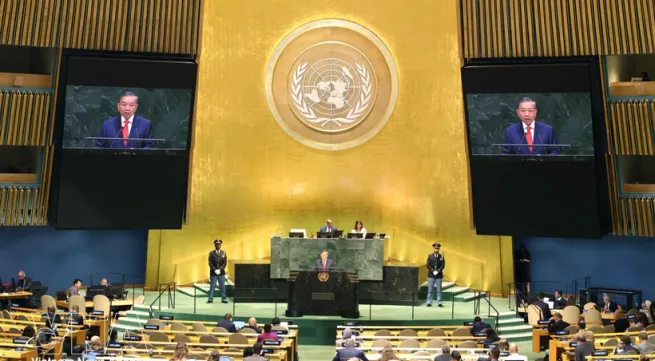
General Secretary of the Communist Party of Vietnam Central Committee and President To Lam used his address at the high-level General Debate of the United Nations (UN) General Assembly’s 81st session in New York on September 22 (local time) to reaffirm Vietnam’s consistent commitment to peace, cooperation and development, according to Assoc. Prof. Dr Bui Hoan Son, Vice Chairman of the Party Central Committee’s Commission for Publicity.
In an interview recently granted to the Vietnam News Agency, Son said the speech carries one consistent message: humanity should not treat confrontation as inevitable in a fast-changing world. Instead, it should proactively manage change through trust, international law, dialogue, cooperation and shared responsibility.
According to him, the speech did not shy away from the world's pressing challenges, including conflict risk, an arms race, economic fragmentation, supply chain disruptions, climate change, pandemics, inequality and the risks emerging from new technology. Its takeaway was not pessimism, though, but a call for responsibility and action.
One line crystallises that spirit: "Change is inevitable, but conflict and confrontation are not". The framing pairs a clear-eyed view of competition with a case for leaving room for dialogue and cooperation. It concedes that power balances are shifting, interests are diverging and competition is intensifying, but insists governments and people still have the ability to choose how they respond. In Son’s view, rebuilding trust is what keeps competition from tipping into confrontation, differences from hardening into conflict, and technology from cutting new divides.
Through the message, Vietnam reaffirmed its consistent commitment to peace, cooperation and development, as well as its continued emphasis on the UN Charter, international law and multilateralism. This was not just a statement of foreign policy, but also a reflection of a country shaped by war that has learned to value independence, peace and reconciliation.
Vietnam's contribution to the global debate is direct: a durable international order can't rest on the balance of power alone. It needs rules, trust, responsibility and benefits that improve people’s lives, the official said.
What stands out most to Son is that the speech puts people at the centre. Restoring trust, reforming global institutional mechanisms, pursuing sustainable development and governing technology all come back to one question: are people safer, freer and better off? That, he said, gives Vietnam's message a clear cultural and humanitarian edge on the world political stage.
The Vice Chairman flagged three points worth particular attention. The first is the idea of restoring trust and managing differences responsibly. The world has no shortage of forums or commitments, but trust remains in short supply. Without it, differences turn into confrontation, competition slips out of control, and international law gets applied inconsistently. Maintaining dialogue, honouring commitments, respecting sovereignty and settling disputes through peaceful means are practical necessities.
The second is the concept of equitable, humane, inclusive and sustainable development. This is consistent with Vietnam’s own development thinking: growth rate alone does not measure progress; quality of life, development opportunity, social equity, environment and the ability to ensure that no one is left behind do too.
The speech's emphasis on respecting each country's history, culture and development stage rules out a one-size-fits-all model. Nations should choose their own path while holding to shared standards of peace, cooperation and responsibility, he noted.
The third is the linkage between Vietnam's strategic autonomy and a new growth model built on productivity, quality, added value, science and technology, innovation and digital transformation tied to cultural development, social progress, equity and environmental protection.
The point, domestically and globally, is that Vietnam does not equate autonomy with isolation. It means having the capacity to rely on its own strengths while engaging with the world on more equal and proactive terms. A country with strong internal capacity, a distinct cultural identity, scientific and technological depth, and broad social consensus adapts to external shocks more easily, Son said.
Overall, he perceived that the four orientations in the speech: trust and international law, inclusive development, technology governance, and stronger multilateralism, share a single philosophy: managing change so that development serves people, peace and shared interests. That is how Vietnam positions itself as an active member, a reliable partner and a responsible player globally.
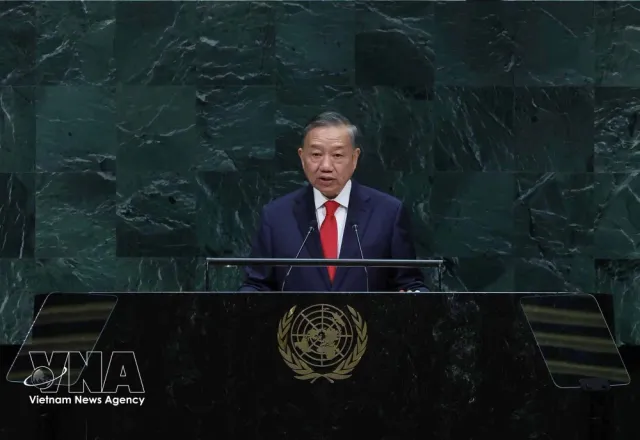
General Secretary of the Communist Party of Vietnam Central Committee and President To Lam addresses the high-level General Debate of the UN General Assembly's 81st session in New York on September 22, 2026. (Photo: VNA)
This is particularly important with regard to artificial intelligence as algorithms become more deeply embedded in production, education, culture, communications, public services and even how societies form perceptions, Son went on.
The speech also calls on developing countries to have a real say in rule-making, plus support for infrastructure, digital capacity and access to scientific and technological advances. Otherwise, there is a risk that if one part of the world controls data, computing infrastructure, platforms and standard-setting while the rest are just users, the digital divide hardens into a new development gap.
Global technology governance, Son said, has to be tied to fair access to opportunity, knowledge and resources.
For Vietnam, he said that's both an integration requirement and a domestic task. The country needs to push innovation, digital infrastructure and a digital workforce, while building matching governance capacity, including timely legislation, digital ethics, data security, protection of children and vulnerable groups, broader digital literacy and a healthier cyberspace culture. The more powerful the technology, the greater the responsibility it demands culturally, socially and humanly.
Vietnam's hosting of the UN Convention against Cybercrime signing in Hanoi in 2025, cited in the speech, backs that up, Son said, adding that adding that the event demonstrated Vietnam’s intention to help establish common norms for cyberspace, rather than simply benefit from technological progress.
The goal, he added, is a safer, fairer, more humane digital order where technology serves people and shared development./
Tags:

More News


43 NGUYEN CHI THANH STREET - BA DINH DISTRICT - HA NOI - VIET NAM
Editor-in-chief: VU THANH THUY
Deputy Editor-in-chief: NGUYEN THI MY HANH, PHAM QUOC THANG, NGUYEN TRONG NINH
Email: toasoan@vtv.vn
Tel: +84 66 897 897
Copyright, VTV News, Vietnam Television (VTV).
Licence No. 483/GP-BTTTT dated December 29, 2023 by the Ministry of Information and Communications.

