Senior Party official affirms continued institutionalisation of Party resolutions
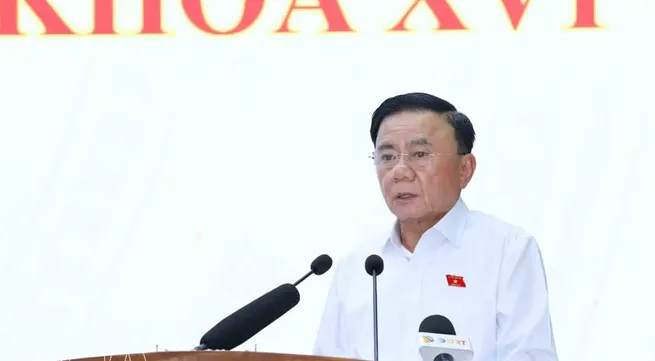
Politburo member and Permanent member of the Party Central Committee’s Secretariat Tran Cam Tu on May 5 affirmed that the Party and State will continue promptly institutionalising the Party's major resolutions into laws, mechanisms and concrete policies so that they can quickly be translated into practice.
Meeting voters in Hoa Khanh, Lien Chieu and Hai Van wards in Da Nang city following the first session of the 16th National Assembly, Tu said this will remain a key task in the coming period, particularly in science and technology, innovation, digital transformation and the continued improvement of the two-tier local administration model.
The official noted that many voters' opinions were practical and closely linked to local realities and people’s daily lives. Matters falling within the competence of the city's authorities should be addressed in a timely manner, while broader issues should be reported to competent central agencies for consideration, he said.
Voters raise concerns over local governance
Eight voters raised opinions at the meeting, focusing on improving the organisation and operation of the two-tier local administration model. They proposed increasing staffing at commune and ward levels to ease pressure in areas facing heavy workloads.
They also called for a more synchronised legal framework on land management, staffing allocations aligned with job positions, improved quality of cadre planning, shorter land-related administrative procedures, and careful study of the location of the passenger terminal for the future high-speed railway line.
Voters in Lien Chieu ward welcomed a number of major resolutions recently issued by the Politburo and the Party Central Committee, including Resolution No. 57 on science, technology, innovation and digital transformation; Resolution No. 59 on international integration; Resolution No. 66 on reforming law-making and law enforcement; and Resolution No. 68 on the private sector's development.
They said the resolutions reflected renewed mindset, long-term vision and strong determination to create new momentum for national development.
At the same time, voters noted that the implementation in some places remained slow and uneven. They pointed to delays in institutionalisation, unclear accountability of heads of agencies, and monitoring and evaluation that in some cases had yet to produce the expected impact.
Clear responsibilities, stronger coordination
Responding to the concerns, Tu said the Party's leaders have consistently identified institutionalisation as a decisive step in bringing the Party's resolutions into life.
He said the Politburo and the Secretariat will continue directing the National Assembly’s Party Committee, the Government’s Party Committee and relevant agencies to urgently review and formulate programmes for amending, supplementing and promulgating laws, decrees, policies and mechanisms immediately after resolutions are issued.
The guiding principle is "clear tasks, clear lead agencies, clear timelines and clear responsibilities" in order to overcome delays in concretising the Party's resolutions, he said.
For inter-sectoral and inter-regional issues, the central authorities will strengthen coordination mechanisms, particularly in science and technology, digital transformation, development of the private sector, education, healthcare and energy. Each task should be assigned to one lead agency to avoid overlap and shifting of responsibility, while ensuring the most timely and effective service for people and businesses.
Tu also stressed the responsibility of heads of agencies and localities. Units performing well will be recognised and commended, while those showing delays or negligence will be reminded, reviewed or handled in accordance with regulations.
He said implementation outcomes, service quality, and satisfaction of citizens and businesses will serve as important criteria in evaluating officials, Party organisations and public agencies.
For dynamic localities such as Da Nang, Tu said the central authorities consistently encourages innovation, initiative and readiness to take responsibility for the common good.
Effective models and creative approaches suited to practical conditions will be considered for pilot implementation, review and wider replication, he added.
Tags:

More News


43 NGUYEN CHI THANH STREET - BA DINH DISTRICT - HA NOI - VIET NAM
Editor-in-chief: VU THANH THUY
Deputy Editor-in-chief: NGUYEN THI MY HANH, PHAM QUOC THANG, NGUYEN TRONG NINH
Email: toasoan@vtv.vn
Tel: +84 66 897 897
Copyright, VTV News, Vietnam Television (VTV).
Licence No. 483/GP-BTTTT dated December 29, 2023 by the Ministry of Information and Communications.

