Martyr identification an order from the heart: PM
Since there remains a large number of unidentified war martyrs while conditions become more difficult as time goes by, strong actions must be taken with a high sense of responsibility and the "repaying debts of gratitude" tradition strongly promoted to deserve the dedications by those falling down for the sake of the Fatherland.
So said Prime Minister Pham Minh Chinh while addressing a hybrid conference on July 25 reviewing the one-year implementation of a plan to collect DNA samples from relatives of unidentified martyrs nationwide.
On behalf of Party and State leaders, PM Chinh expressed deep gratitude to war heroes, martyrs, heroic Vietnamese mothers, wounded and sick soldiers, and martyrs’ relatives for their contributions as the country celebrate the 78th anniversary of the War Invalids and Martyrs’ Day (July 27, 1947–2025).
He emphasised that collecting DNA samples of unidentified martyrs’ relatives is a highly humanistic programme that is "an order from the heart" and reflects the sense of responsibility towards the persons laying down their lives for the Fatherland’s independence and freedom, as well as the people’s happiness.
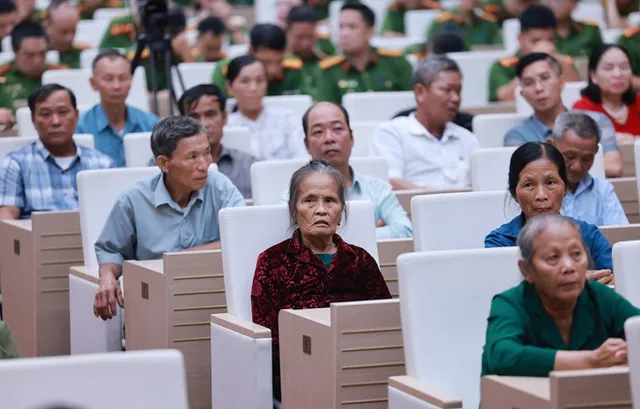
Representatives of martyrs' families attend the conference. (Photo: VNA)
Appreciating efforts by public security and military forces, as well as people and businesses, to collect DNA samples, he said: "Compared to the sacrifices by martyrs and the contributions by their families, no matter how much we do, it is never enough!"
Vietnam has more than 1.2 million martyrs in the struggles for national independence, freedom and reunification, as well as the noble international missions. Remains of over 900,000 martyrs have been repatriated, but about 300,000 are still unidentified. Meanwhile, there are about 652,000 wounded soldiers, 198,000 sick soldiers, 132,000 heroic Vietnamese mothers, and 320,000 individuals affected by Agent Orange/dioxin, he noted.
Therefore, the identification of martyrs is still an "urgent task", especially amid impacts of time and weather, PM Chinh pointed out, stressing that DNA identification is not only to find out biological information but also key to recovering historical memories for their families, and connecting the past, the present, and the future.
The Party and State view the search for and repatriation of martyrs’ remains and their identification as an important and sacred duty of the entire political system and society. It requires utmost dedication, wisdom, technology application, compassion, industriousness, along with support from people and businesses, he noted.
The Government leader asked all-level authorities, sectors, localities, the whole political system, the Vietnam Fatherland Front, mass organisations, and people to join hands with the public security force to collect DNA samples of martyrs’ relatives. He also called for allocating budget and mobilising private funding for the DNA analysis and sequencing.
He demanded stronger efforts to access every family of martyrs, especially those in remote, ethnic minority, and disadvantaged areas. Regular review and examination were urged to promptly address any problem arising.
Assigning tasks to ministries, localities, and organisations, PM Chinh described the application of DNA technology to martyr identification and the building of a martyr database and genetic bank as a big scientific and legal step to fulfil the duty.
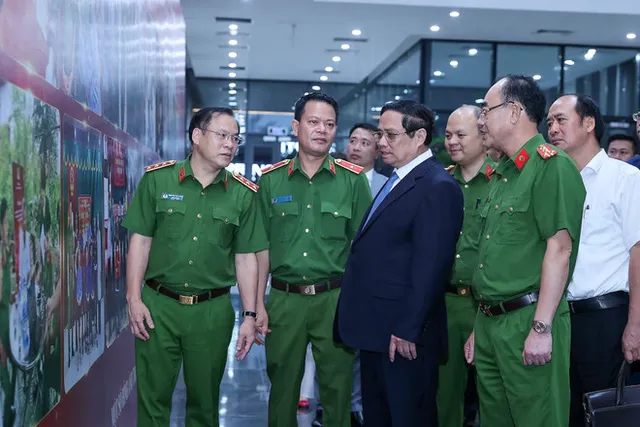
PM Pham Minh Chinh and public security officials look at photos on martyrs' DNA testing activities. (Photo: VNA)
Sixteen cases of martyrs’ DNA samples have been found to match the maternal relationship with the DNA samples of 27 martyrs’ relatives. C06 has worked with the Ministry of Home Affairs to complete procedures for recognising the identities of these 16 martyrs./
Tags:

More News


43 NGUYEN CHI THANH STREET - BA DINH DISTRICT - HA NOI - VIET NAM
Editor-in-chief: VU THANH THUY
Deputy Editor-in-chief: NGUYEN THI MY HANH, PHAM QUOC THANG, NGUYEN TRONG NINH
Email: toasoan@vtv.vn
Tel: +84 66 897 897
Copyright, VTV News, Vietnam Television (VTV).
Licence No. 483/GP-BTTTT dated December 29, 2023 by the Ministry of Information and Communications.

