Hunan Broadcasting’s Digital Transformation Experience and Insights for VTV
As digital technology continues to reshape the global media industry, broadcasters are increasingly shifting their focus from traditional television to multi-platform digital media. The Hunan Broadcasting System (HBS) is a notable example in China, with a digital ecosystem built around MangoTV and other digital platforms.
A recent study visit revealed that HBS’s transformation extends beyond technology to organizational structure, production, governance, and business models. HBS's experience offers valuable lessons for Vietnam Television (VTV) as it advances its own digital transformation strategy.

Hunan Broadcasting System holds the opening ceremony of a digital transformation exchange and training program for a delegation from Vietnam Television.
1. Digital transformation is essential for modern media
The rise of the Internet, social media, AI, and online video has transformed audience behavior, prompting broadcasters to reconsider traditional operating models. Digital transformation, therefore, requires not only new technologies but also fundamental changes to how broadcasters operate.
HBS took this approach in 2014, sacrificing over RMB 3 billion in annual program licensing revenue to prioritize MangoTV and its digital platforms. It also streamlined underperforming channels and redirected resources toward its digital ecosystem, prioritizing long-term digital value over short-term television revenue.
2. From “making television” to building a digital media ecosystem
A key transformation for HBS has been shifting from a television-centered model to a user-centered digital media ecosystem. Content is now designed for distribution across television, over-the-top (OTT) services, websites, social media, and mobile devices.
Rather than operating television and digital platforms separately, HBS integrates them into a unified ecosystem, allowing content to be produced once and distributed across multiple platforms, formats, and business models.
3. Content at the core, technology as the driving force
HBS does not view technology not as an end in itself, but rather as a tool to strengthen content and enhance the user experience.
The broadcaster develops strong content IPs that can be repurposed across platforms, including television programs, short-form videos, podcasts, social media, and interactive content. This strategy extends content lifecycles, broadens audience reach, and creates new revenue opportunities.
4. Data as a strategic asset
A key factor behind HBS’s success is its unified data platform, which integrates real-time data from production, broadcasting, digital platforms, social media, and user behavior. This data informs management decisions, content creation, advertising optimization, and personalized audience experiences.
As a result, data has evolved from stored information into a strategic asset that informs both management and business decisions.
5. AI supports human creativity
HBS has integrated AI into various workflows, including speech recognition, subtitling, translation, archive searches, trend analysis, content recommendations, and editorial support.
AI reduces repetitive tasks and improves productivity, allowing journalists and editors to focus on creative work, while ensuring that human expertise remains central to the content production process.
6. Transforming organizational and governance models
Digital transformation at HBS has been accompanied by organizational restructuring, with departments being integrated into multi-platform content production centers. Workflows have also shifted toward a “One Source - Multi Use” model, enabling content to be distributed across multiple platforms while optimizing resources and operational efficiency.
At the same time, governance and management have been digitalized, with data and intelligent dashboards playing an increasingly important role in decision-making and daily operations.

Delegates attend the digital transformation exchange and training program.
7. Key Insights for VTV
HBS’s experience shows that a successful digital transformation requires coordinated changes in strategy, organizational structure, technology, and governance.
For VTV, several key areas can be considered:
(1) Digital transformation should involve comprehensive organizational and operational change rather than simply investing in technology or standalone software systems.
(2) VTVgo should be strengthened as the central digital platform for VT, connecting traditional television with Internet platforms and a broader digital service ecosystem.
(3) An Enterprise Data Platform should be built, integrating Data Platform, Big Data, Metadata Spine, and Data Spine capabilities to make data a strategic asset for management, production, and business operations.
(4) An AI Factory should be developed as a shared AI foundation for content creation, workflow optimization, and more efficient governance.
(5) Advance toward a Digital First production model, designing content from the outset for multi-platform distribution and diverse audience segments.
(6) Prioritize the long-term value of digital platforms. VTV should balance short-term economic returns with long-term ecosystem development to position VTVgo as a primary destination, thereby expanding its user base, enriching audience data, and supporting future digital services.
(7) Restructure channels and resources in line with digital media trends. Based on performance assessments, VTV should optimize its content distribution system and concentrate resources on platforms with strong long-term potential, while continuing to fulfill its political, public-service, and audience responsibilities.
(8) Selectively adapt international experience to VTV’s specific context. As Vietnam’s national broadcaster, VTV has responsibilities that differ from commercial media organizations. The objective is therefore not to replicate HBS’s model, but to apply relevant practices in developing a digital transformation model that reflects VTV’s identity.
Data and artificial intelligence - new foundations for Vietnam Television’s development in the digital era. (Image created with AI assistance)
HBS’s experience shows that digital transformation involves more than simply putting television content online or adopting new technologies. It requires comprehensive changes to mindset, organization, production, governance, and value creation.
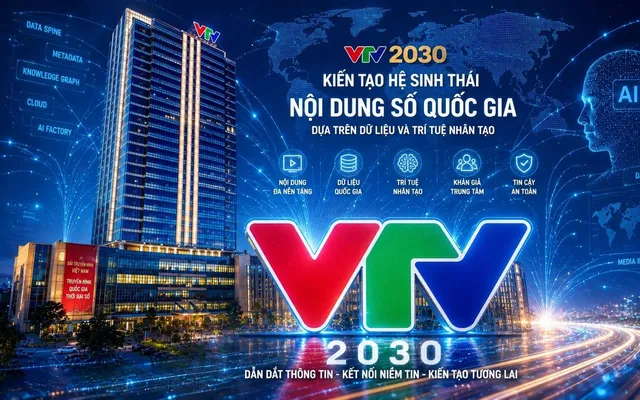
VTV has already laid built important foundations through archive digitization, digital production and broadcasting workflows, VTVgo and VTV Ratings development, and the adoption of big data and AI.
With the VTV Digital Architecture 2030 and the development of Hybrid Cloud, Enterprise Data Platform, Media Platform, and AI Factory, VTV is well-positioned to evolve from a traditional broadcaster into a data- and AI-driven, multi-platform media organization. This transformation will further strengthen VTV’s role as Vietnam’s national broadcaster while building a modern media ecosystem where content is at the core, technology is the driving force, data is a strategic resource, and audiences are at the center.
Tags:

More News





43 NGUYEN CHI THANH STREET - BA DINH DISTRICT - HA NOI - VIET NAM
Editor-in-chief: VU THANH THUY
Deputy Editor-in-chief: NGUYEN THI MY HANH, PHAM QUOC THANG, NGUYEN TRONG NINH
Email: toasoan@vtv.vn
Tel: +84 66 897 897
Copyright, VTV News, Vietnam Television (VTV).
Licence No. 483/GP-BTTTT dated December 29, 2023 by the Ministry of Information and Communications.

