Hengdian: From rural fields to the world’s largest film studio
The Zhejiang visit kicked off in Hangzhou, China, bringing together 11 think tank scholars and media professionals from ASEAN countries including Malaysia, Indonesia, Laos, Myanmar and Vietnam. Alongside their Chinese counterparts, they embarked on a week-long exchange themed "Digital Intelligence Empowering Better Lives," exploring how Zhejiang leverages smart technologies to enhance public welfare and improve people’s livelihood.
As part of the program, the delegation visited Hengdian World Studios to experience how cultural industries and digital innovation are transforming local communities and driving inclusive development in China’s countryside.
Hengdian World Studios, located in Dongyang City, is recognized as the world’s largest film and television shooting base. Since its founding in 1996, the complex has constructed more than 50 large-scale film sets, covering historical periods from the Spring and Autumn and Warring States to the Republic of China—a span of 5,000 years of Chinese civilization. By 2024, Hengdian had hosted more than 4,800 domestic and international film crews. It is estimated that one-quarter of all Chinese films and two-thirds of costume dramas are shot there.
Where history and cinema meet
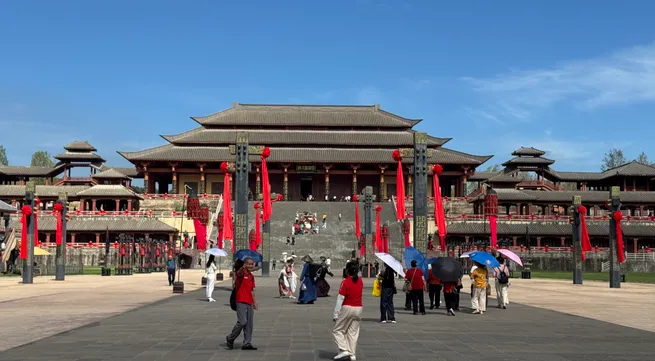
The tour typically commences at the Qin Palace Scenic Area (Qin Wang Gong), the second major scenic site fully funded and constructed by the Hengdian Group after Guangzhou Street. The site was built in 1997 specifically for director Chen Kaige’s film The Emperor and the Assassin. Covering 800 mu (about 53 hectares), the entire palace complex was completed in only eight months.
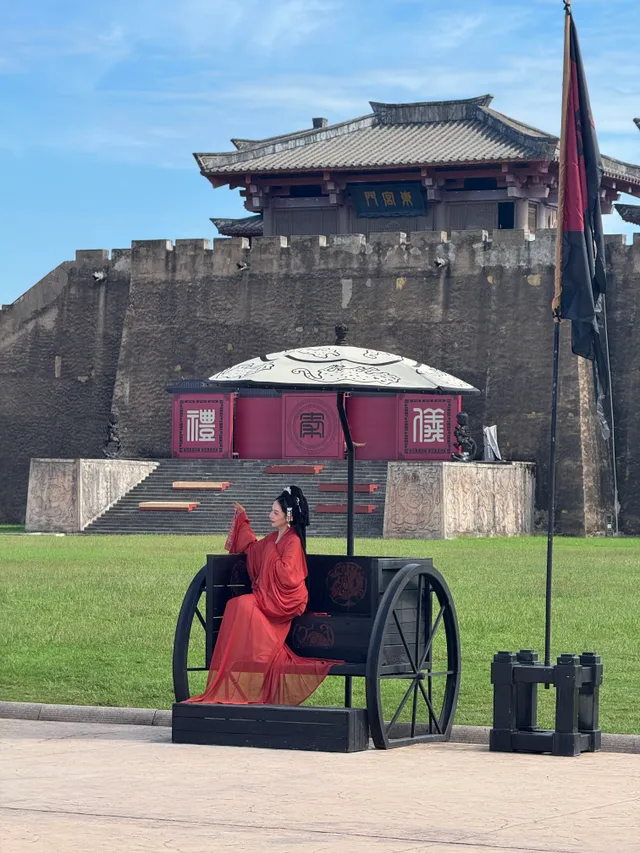
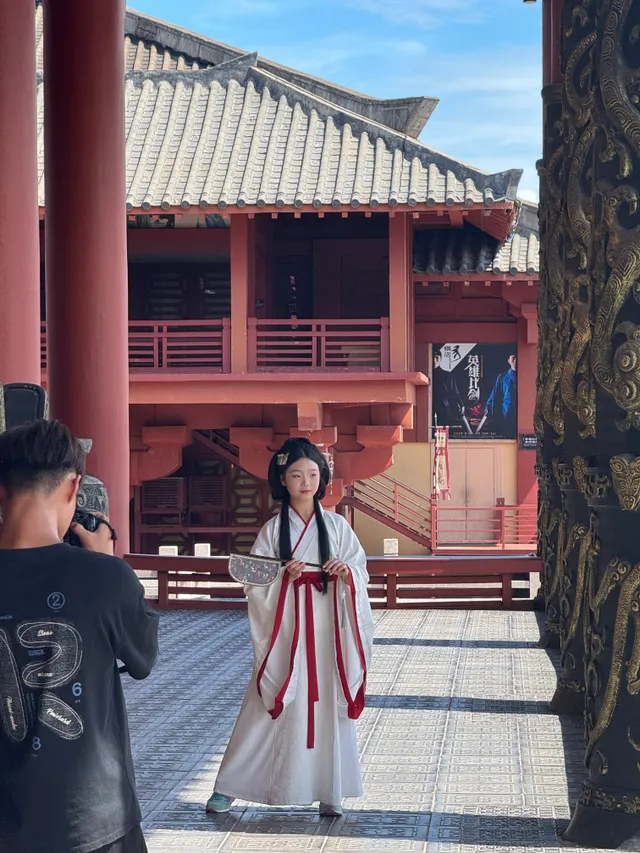
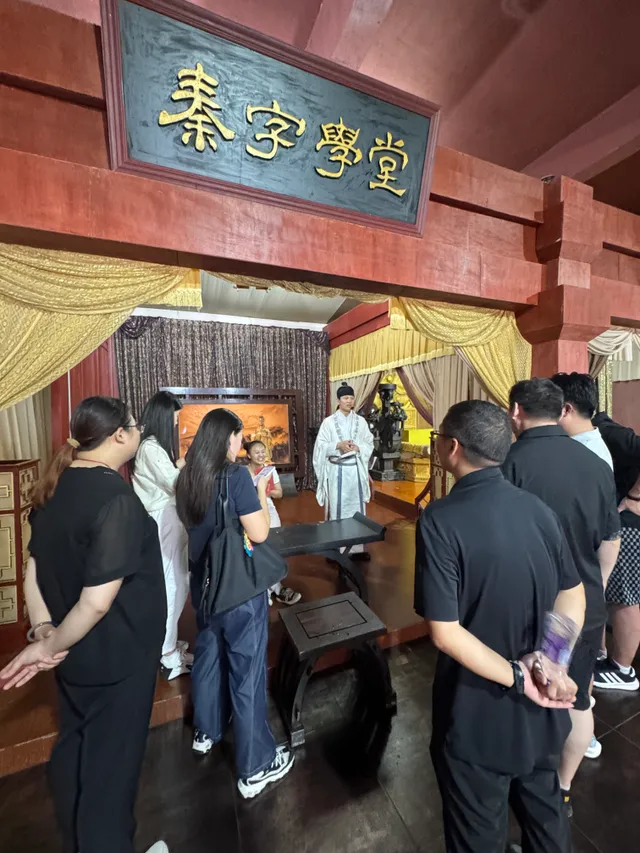
Guests exploring Hengdian World Studios
Visitors enter through the main gate, which historically functioned as the passageway for emperors setting out on inspections or leading troops to war. The front square served both as the first line of military defense and the venue for grand entertainment events. On either side, the Que Towers stand as ornamental structures that once symbolized hierarchy and served as monuments to rank and merit. The complex is dominated by the Hall of Four Seas Unity, the main hall, which extends 120 meters deep and stands 44.8 meters tall. The front steps consist of the 99 stone steps, a number symbolizing eternity and embodying the emperor's wish for long-lasting stability.
The palace’s defensive system is particularly noteworthy at the Central Palace Gate, which is composed of three separate gates. The first defense is the Thousand-Jin Gate, featuring beast-faced knockers shaped like Jiaotu, one of the nine sons of the dragon, symbolizing protection. Because Jiaotu was believed to transmit sound, a copper ring was often added below to serve as a knocker, as knocking directly on a door was considered impolite in ancient times. The second defense is the Spike Gate, which utilized sliding grooves and could lock the passage as if with forty bolts. The final defense is the Portcullis, which would be dropped in an instant when enemies attacked, cutting off the main passage. Together, these three defensive gates made the imperial palace virtually impregnable.
Inside, visitors walk the Double-Corridor Passage (Fudao), the main route used by ministers and by Qin Shi Huang when traveling incognito. This passage is a popular filming site, and visitors can now experience the snow-covered scenery often recreated for famous dramas like The Untamed. The Hall of Four Seas Unity is divided into three parts. The Front Hall was where all weapons and armor had to be surrendered due to Qin Shi Huang’s history of assassination attempts. The Middle Hall features a pool, which served to humidify the dry climate of Shaanxi and acted as a water source for fire prevention, given the wooden structure of ancient palaces. The Rear Hall is the true audience chamber, where the emperor’s throne—the Dragon Couch—stood, backed by the Four Seas Unity Columns, symbolizing imperial dominion over all under heaven.
The tour proceeds to the Rear Square, or "Four Seas Unity Square," where grand ceremonies took place. The set’s adaptability is shown by its transformation when the entire area was covered in sand for the film The Mummy: Tomb of the Dragon Emperor. At the center stand eight black Dragon Columns, the prototypes of Huabiao ornamental pillars, symbolizing the unification of all under heaven. The Qin Palace experience culminates with the immersive flying theater show, Empire’s Majesty, which reenacts Qin King Ying Zheng’s conquest of the six rival states (230–221 BCE). This project, opened in October 2019, cost 80 million yuan and has received more than four million visitors.
From a village to the world’s largest film studio
The journey continues at the Riverside Scene at Qingming Festival Scenic Area, the third scenic area, constructed in December 1997 and opened in November 1998. It is modeled after the famous painting Along the River During the Qingming Festival by the Northern Song court painter Zhang Zeduan, depicting life in the capital, Bianjing. The scenic area primarily restores the "Crossing the Rainbow Bridge" and "City Life" sections of the painting. Visitors enter the main city area through Shangshan Gate, named after the Daoist phrase "Supreme Goodness is Like Water". The Imperial Street (Yujie) is a location frequently used for bustling street scenes in costume dramas. Landmarks include the Sunyang Official Tavern, an imperial-licensed state-owned establishment comparable to a three-star hotel, advertised by a tall bamboo arch called a huanmen cailou. Fanlou, the largest and most luxurious of Bianjing’s 72 official taverns, was likened to a modern state guesthouse and was called the "Palace of the Common People".
A signature large-scale acrobatic show, A Dream of Bianjing, is performed at the end of Imperial Street. Beyond the main street is the Lesser Imperial Street (Xiaoyujie), a luxury entertainment district, where brothels functioned as high-end clubs where courtesans sold their artistic skills (music, chess, calligraphy, painting). The area also houses the Great Song Folk Life Museum. The tour also covers the Shuipo Liangshan Area, which includes Sun Erniang’s Steamed Bun Shop. This area is included because the events of Water Margin are set in the same Song Dynasty era as the Qingming Festival painting. All landscapes in Hengdian, including the wide plains and water features, are man-made, having been developed through mountain reshaping and reconstruction.
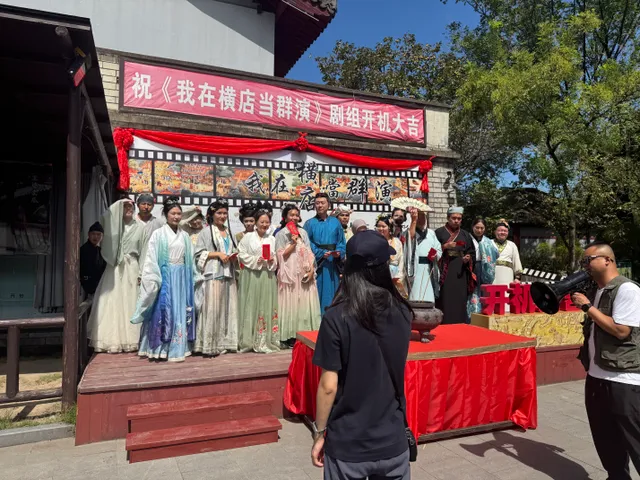
A crucial element of Hengdian’s success lies in its production efficiency. Most houses used for filming, such as the famous Cai Jing Mansion (featured in Empresses in the Palace and Nirvana in Fire), are empty shells inside. Crews simply change the plaques and props to transform the same building into different mansions for various dramas, a design that greatly facilitates set decoration and filming.
Hengdian provides a complete supporting industry chain, meaning film crews only need to bring their cast, script, and staff. The local extras' guild currently has over 100,000 registered extras. The only strict requirement for female extras is that their hair must be long, straight black. This ecosystem also supports new tourism models like "Film & Tourism + Museum" and "Film & Tourism + Education," offering immersive study tours where students can experience acting through costume changes, script readings, and scene rehearsals.
Beyond film and television tourism, the Hengdian Group also operates in three other major industries: electronics and electrical manufacturing, pharmaceuticals and chemicals, and comprehensive services. The founder, Mr. Xu Wenrong, was driven by the belief that "every one yuan invested in cultural industries can generate five yuan in related income".
This strategy has transformed the area. After more than 20 years of development, Hengdian has achieved a development model where "every household runs guesthouses, every family engages in tourism, and everyone earns income". This ensures that local residents of all ages benefit. Hengdian has realized the dream of "industrializing the countryside, urbanizing rural areas, and turning farmers into citizens," transforming a rural village into a prosperous, modern town.
Tags:

More News




43 NGUYEN CHI THANH STREET - BA DINH DISTRICT - HA NOI - VIET NAM
Editor-in-chief: VU THANH THUY
Deputy Editor-in-chief: NGUYEN THI MY HANH, PHAM QUOC THANG, NGUYEN TRONG NINH
Email: toasoan@vtv.vn
Tel: +84 66 897 897
Copyright, VTV News, Vietnam Television (VTV).
Licence No. 483/GP-BTTTT dated December 29, 2023 by the Ministry of Information and Communications.

