Hanoi plans major bus network overhaul to accelerate green transition
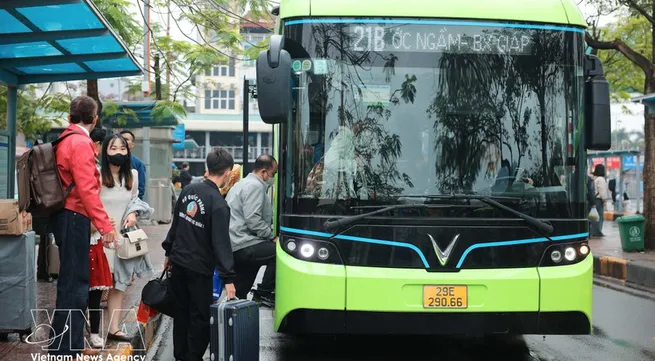
The Hanoi Centre for Traffic Management and Operation has proposed a plan to adjust and strengthen the city's bus network to reduce emissions and promote sustainable urban transport development, the municipal Department of Construction announced on March 30.
Under the plan, Hanoi targets that by July 1, 2026, all buses operating within Ring Road 1 will use green energy (electricity or compressed natural gas – CNG). The policy will then be expanded to Ring Road 2 by January 1, 2028, and further extended to Ring Road 3 from 2030. This is considered an important step in the roadmap to establish low-emission zones in line with Directive No. 20/CT-TTg issued by the Prime Minister.
To meet these goals, the city will implement adjustments to the bus network in three phases. In the first phase, starting from July 2026, many routes will remain unchanged, while green vehicle conversion will be required for selected routes. At the same time, the itineraries and terminals of several inner-city routes will be adjusted. Notably, Hanoi plans to launch 12 new bus routes to enhance connectivity among urban areas, bus stations, and industrial parks.
In the second phase from 2028, the city will continue to maintain, adjust, and convert additional routes, while introducing six new bus routes linking densely populated areas and key transport hubs. By 2030, when the network is largely completed and all vehicles have been converted to green energy, Hanoi will not prioritise opening new routes but will instead focus on stable operations.
At present, Hanoi’s bus network covers 100% of communes and wards, with 155 routes in operation, including 128 subsidised ones. The total fleet exceeds 2,200 vehicles, of which more than 1,500 meet Euro IV emission standards or higher.
The infrastructure system comprises over 5,000 bus stops, along with hundreds of shelters and transfer points, serving as the backbone of the public passenger transport network. However, the proportion of buses using clean energy remains limited, particularly in ring road areas.
The expansion of electric buses, the addition of new routes, and the optimisation of operations are expected not only to ease traffic pressure but also to improve the urban environment, moving towards a green, modern, and sustainable transport system for the capital city./.
Tags:

More News

43 NGUYEN CHI THANH STREET - BA DINH DISTRICT - HA NOI - VIET NAM
Editor-in-chief: VU THANH THUY
Deputy Editor-in-chief: NGUYEN THI MY HANH, PHAM QUOC THANG, NGUYEN TRONG NINH
Email: toasoan@vtv.vn
Tel: +84 66 897 897
Copyright, VTV News, Vietnam Television (VTV).
Licence No. 483/GP-BTTTT dated December 29, 2023 by the Ministry of Information and Communications.

