Experts stress importance of maternal immunization in protecting newborns from RSV
Speaking at the event, Associate Professor Dr. Vu Van Tam, Vice President of the Vietnam Association of Obstetricians and Gynecologists (VAGO) and Director of Hai Phong Obstetrics and Gynecology Hospital, noted that maternal antibody transfer is vital for safeguarding infants in the first months of life, when their immune systems are not yet fully developed.
A symposium on maternal immunization, jointly organized by VAGO and Pfizer Vietnam, gathered leading clinicians and researchers from across the country. Discussions focused on three themes: the role of maternal immunization in preventing infectious diseases, its potential to reduce RSV-related pneumonia in newborns, and strategies for broader community protection against RSV.
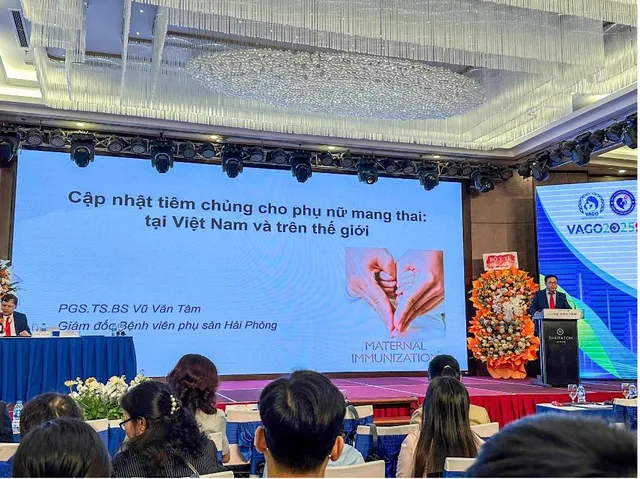
Associate Professor Dr. Vu Van Tam, Vice President of the Vietnam Association of Obstetricians and Gynecologists (VAGO) and Director of Hai Phong Obstetrics and Gynecology Hospital, delivers a speech
According to the World Health Organization (WHO), nearly all children are infected with RSV by the age of two. In 2019, the virus caused an estimated 33 million cases of acute lower respiratory tract infections, more than 3.6 million hospitalizations, and over 100,000 deaths among children under five, with the vast majority occurring in low- and middle-income countries.
Dr. Huynh Nguyen Khanh Trang, Head of Obstetrics at Hung Vuong Hospital, noted that RSV hospitalizations occur most frequently in the first three to six months of life. She warned that RSV infections can lead to both immediate and long-term complications, including pneumonia, bronchiolitis, impaired lung function, and asthma.
Professor Nguyen Viet Tien, President of VAGO, added that while maternal immunization is supported by major health organizations, awareness remains limited. A study in Southern England showed that 88% of pregnant women had little or no knowledge of RSV. He stressed the role of healthcare professionals in counseling expectant mothers about the risks of RSV and the benefits of maternal antibody transfer, which can provide protection for at least the first six months of life.
According to Dr. Bach Thi Chinh, Medical Director of VNVC Vaccination Center, 60 countries have now approved maternal immunization approaches against RSV. The WHO, in its 2025 update, recognized these measures as an important step in reducing RSV-related disease in infants.
Experts stressed that maternal immunization can help bridge this critical window of vulnerability. Antibodies transferred from mothers to infants during pregnancy have been shown to provide protection lasting at least six months after birth. Despite this, awareness remains limited. Citing research in Southern England, Professor Nguyen Viet Tien, President of VAGO, highlighted that up to 88% of pregnant women surveyed knew little or nothing about RSV. He underlined the importance of counseling and community education to improve uptake of preventive measures.
Globally, more than 60 countries have approved maternal immunization approaches against RSV. WHO’s 2025 update also includes recommendations on preventing RSV-related lower respiratory tract disease in infants through maternal antibody transfer.
Vietnamese experts agreed that enhancing healthcare providers’ capacity to counsel pregnant women is essential for improving prevention efforts. They emphasized that maternal immunization, particularly between the 24th and 36th week of pregnancy, offers an important opportunity to reduce infant mortality and disease burden associated with RSV.
Tags:

More News





43 NGUYEN CHI THANH STREET - BA DINH DISTRICT - HA NOI - VIET NAM
Editor-in-chief: VU THANH THUY
Deputy Editor-in-chief: NGUYEN THI MY HANH, PHAM QUOC THANG, NGUYEN TRONG NINH
Email: toasoan@vtv.vn
Tel: +84 66 897 897
Copyright, VTV News, Vietnam Television (VTV).
Licence No. 483/GP-BTTTT dated December 29, 2023 by the Ministry of Information and Communications.

